Showing posts with label Spiritual. Show all posts

Tuesday, August 29, 2006

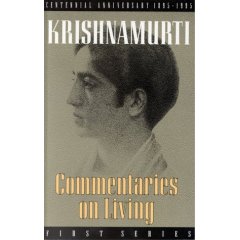
Commentaries On Living : J Krishnamurthy


Jiddu Krishnamurthy, the sage who would'nt be guru, had declined to accept the throne of the world master in 1930. The order of the star of the east was offered to krisnamurthy by Annie Besant the then chief of Theosophical Society. He was brought up by Annie Beasnt & Leadbeater in order to become the world master that they were awaiting. The twist in the tale came with the awakening of Krishnamurthy & he announced that truth can never be organised or cannot be sought with the help of any guru.

He died in 1986 in Ojai USA.

Although he refused any kind of guruhood but he went on to become a world reknowned teacher & preacher of his own experiences in the form of his discourses & writings. A small group also flourished around him by the name of Krishnamurthy Foundation.

Commenataries On Living is one of the many writings by Krishnamurhty. In this book he talks in details about every aspects of human life.

some excerpts from the book:-

The mind moves from the known to the known, and it cannot reach out into the unknown. You cannot think of something you do not know; it is impossible. What you think about comes out of the known, the past, whether that past be remote, or the second that has just gone by. This past is thought, shaped and conditioned by many influences, modifying itself according to circumstances and pressures, but ever remaining a process of time. Thought can only deny or assert, it cannot discover the new.

Disciplines, renunciations, detachments, rituals, the practice of virtue—all these, however noble, are the process of thought; and thought can only work towards an end, towards an achievement, which is ever the known. Achievement is security, the self-protective certainty of the known. To seek security in that which is nameless is to deny it. The security that may be found is only in the projection of the past, of the known.

For this reason the mind must be entirely and deeply silent; but this silence cannot be purchased through sacrifice, sublimation or suppression. This silence comes when the mind is no longer seeking, no longer caught in the process of becoming. This silence may not be built up through practice. This silence must be as unknown to the mind as the timeless; for if the mind experiences the silence, then there is the experiencer who is cognizant of a past silence; and what is experienced by the experiencer is merely a self-projected repetition. The mind can never experience the new, and so the mind must be utterly still. The mind can be still only when it is not experiencing, that is, when it is not terming or naming, recording or storing up in memory.


This book, I love a lot.

Saturday, August 26, 2006

Tao Te Ching : Lao-tzu


Tao Te Ching roughly translated as the 'The Way & It's Virtue' was written by Lao-tzu in around 600 B.C.
Lao-tzu, a chinese philosopher & contemprory of Buddha, was considered to be a man of wisdom in his country. Somewhat eccentric in nature, Lao-tzu, talks about the way to enlightenment in a very awkward way. The name Lao-tzu means the old man. Since his childhood he was as wise as any old man & that's why he was named as such.

Tao Te Ching being the only book written by Lao-tzu carries a very strange & interesting story behind it's creation.
Lao-tzu, on the order of king of China was caught on the borders when he was on his last journey towards the Himalayas. The king's order were very clear that Lao-tzu should not be allowed to go untill & unless he writes his teachigs in form of a book. Miserably, Lao-tzu wrote Tao Te ching. But did'nt wrote a single word about Tao(the way) in the whole book.

He starts the book with these sentences:-

The Tao that can be told of is not an Unvarying Tao;
The names that can be named are not unvarying names.
It was from the Nameless that Heaven and Earth sprang;
The named is but the mother that rears the ten thousand creatures,
each after its kind.


On the introductory page Lao-tzu writes:-
My words are very easy to understand ; yet no one under heaven understands them.

The Tao Te Ching can be seen as advocating mostly "feminine" (or Yin) values, emphasising the qualities of water — fluidity and softness (instead of the solid and stable mountain), choosing the obscure and mysterious aspect of things, and controlling things without ruling them, in other words to 'have without possessing'. In this respect, this book can be understood as challenging "male" (or Yang) values such as clarity, stability, positive action, and domination of nature; such values are often referred to as Confucian values. Yet a perfect balance between the Yin and Yang is still encouraged.

Something more of wisdom from the book:-

So a wise leader may say: I practice inaction, and the people look after themselves

Knowing others is wisdom;
Knowing the self is enlightenment.
Mastering others requires force;
Mastering the self requires strength;

The contrast of opposition — i.e. the differences between male and female, light and dark, strong and weak, etc. — helps us understand and appreciate the universe.

The harder one tries, the more resistance one will create for oneself.

When the spring comes, grass grows on it's own.


This book, I love a lot.
Wednesday, August 16, 2006

Zen Flesh, Zen Bones : Paul Reps


Zen Flesh, Zen Bones is an amazing book & it’s was fortunate on my part to be a part of all those who are in love with this book.
This book is actually a compilation by Paul Reps. He has simply translated the Zen stories & I should add that he has done a marvelous job.
I have seen many books on Zen but Zen Flesh, Zen Bones is a mile-stone as far as the Zen philosophy is concerned,

The best thing about the book is this that Paul Reps has not added a single word from his side. He tried to be very fair ; in this regard even D. T. Suzuki has also failed.
Although Suzuki’s approach is no less than that of Zen master’s but still his work on Zen lags far behind from Paul Reps’s.

Apart from Zen stories this book also contains 112 meditative techniques of Lord Shiva. In Hindu mythology these techniques are compiled in a book called Vigyan Bhairav Tantra. Paul Reps when came to India visited a famous saint in Kashmir. The saint was Lakshmanju. From him Paul Reps came to know about the ancient hindu meditative techniques.

Zen Flesh, Zen Bones is a very small book; pocket size.
Paul Reps picked up the name for his book from a very interesting story :
Bodhidharma, when asked his disciples about the Zen, the firs one replied that Zen is this world. Bodhidharma said you have skin of Zen. The second one replied that not only earth but also sky is Zen. Bodhidharma said you have Zen flesh. The third one replied that universe is made up of four elements & the fifth unknown element is Zen. Bodhidharma said you Zen bones. The fourth disciple did not said anything; he just kept quite. The Bodhidharma said you have Zen marrow.
So, the name Zen Flesh, Zen Bones comes from this story. The Zen marrow is not added in the title simply because it cannot be said.
That which cannot be spoken about, must be passed over in silence--- Ludwig Wittegenstein.

The Zen stories are one of the most complicated things in this world. Although, being an engineering student, complication was never a problem for me but speaking frankly Zen stories are even more complicated than cracking CAT or UPSC.
Just read some of them & one will find me correct.

But I will narrate a very simple story just to make the reader aware of the taste of Zen :

Once a warrior came to Hakuin ( famous Zen master).
He asked Hakhuin , ‘ Do you know anything about the heaven & hell ?’.
Hakuin said , ‘ Who are you ?’
He said, ‘ I am a warrior.’
Hakuin replied, ‘ Well, you look like a beggar instead of warrior.’
On hearing this the warrior felt offended & drew out his sword.
Hakuin said, ‘ Oh! So you have a sword too. From here my son, opens the gate to hell.’
Instantly the warrior felt that he was going to do something wrong. He placed the sword back & touched the feet of Hakuin.
Hakuin said, ‘ And from here my son, opens the gate to heaven.’

This book, I love a lot

Monday, August 07, 2006

Kabir Granthavali


Another book that I am mentioning here is the jewel of Indian mysticism. The book is Kabir Granthavali. It is the parables of great Indian mystic Kabir.

Kabir was a rebellious spirit & was the most influential mystic in 15th century. He was incomparable. Being a sooth-sayer along with a blend of criticism of organized religion, makes Kabir stand at the peak of spiritualism.

I came across Kabir a few years ago & was simply taken aback with his innovative writing method. But if I am truly being asked I would say that he was the preacher of love, as the world has never seen before.

Only by understanding Kabir one can easily understand the very core of religion & religiousness.

This book, I love a lot.

Sunday, August 06, 2006

Siddhartha : Hermann Hesse


Another book which I am in deep love with is Hermann hesse's Siddhartha.
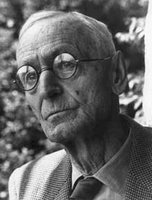
Hermann Hesse (1877-1962), German poet and novelist, who has depicted in his works the duality of spirit and nature, body versus mind and the individual's spiritual search outside the restrictions of the society. Hesse was awarded the Nobel Prize for Literature in 1946.

Siddhartha is the story of a brahmin boy who yearns for enlightenment. He leaves his home with the obvious permission of his father, accompanied by his friends.
After several years of wandering they come to meet Gautam The Buddha. But Siddhartha leaves the comapany of Buddha himself even after the persuasion by his friend not to do so.
Later on, Siddhartha wents to live a very material life inspite of his yearn for enlightenment.
But Siddhartha attains the enlightenment conclusively without the help of any master.

What Heramann Hesse did in this small story of his , simply shows his grasp of eastern spiritualism. Every dialogue between the Buddha & Siddhartha is noteable.

This book, I love a lot.

Sunday, July 23, 2006

Mrityunjaya : Shiwaji Sawant


The search for the meaning of Being is man's eternal quest and the subject of his greatest creations. Shivaji Sawant's Mrityunjaya is an outstanding instance of such a literary masterpiece in which a contemporary Marathi novelist investigates the meaning of the bewildering skein that is life through the personae of the Mahabharata protagonists. For over two decades since its first publication the vast non- Marathi and non-Hindi readership remained deprived of this remarkable exploration of the human psyche till the publication of this English translation by the Writers workshop – a contribution for which there is much to be grateful for.

Mrityunjaya is the autobiography of Karna, and yet it is not just that. With deceptive case, Sawant brings into play an exceptional stylistic innovation by combining six "dramatic soliloquies" to form the nine books of this novel of epic dimensions. Four books are spoken by Karna. These are interspersed with a book each from the lips of his unwed mother Kunti, Duryodhana (who considers Karna his mainstay), Shon (Shatruntapa, his foster-brother, who here-worships him), his wife Vrishali to whom he is like a god and, last of all, Krishna. Sawant depicts an uncanny similarity between Krishna and Karna and hints at a mystic link between them, investing his protagonist with a more-than-human aura to offset the un-heroic and even unmanly acts which mar this tremendously complex and utterly fascinating creating of Vyasa.
The beginning of the novel is riveting in its newness and simplicity: "I want to say something today.... a time comes when the dead have to speak too. When this flesh-and-bones living behave like the dead, then the dead have to come alive and speak out". That is Sawant's pregnant comment on the state of contemporary society, where class and caste ride roughshod over innate worth; where the most intimate ties are denied for the sake of conformity with social norms.
This blunt beginning is immediately capped with a succession of images. Memories are like peacock feathers or like vakula blossoms that fade but leave their fragrance behind; life's events disperse like herds of wild horses galloping crazily after ear-splitting flashes of lightning crash in a forest; life is a temple with Champanagari as its sweetest tinkling bell.

Sawant begins very much in the manner of an epic film, giving us first a panoramic view of life as a battlefield strewn with arrows and flashes of disparate memories of things past lighting up the gloom, with Karna's voice-over. He then zooms down in a sudden change of mood, to focus on "creeper-covered, bird-and –beast haunted" Champanagari where Karna's earliest memories begin. And why all this? "For one reason only", says Sawant's Karna. "To make sense of it for myself". And in that very reason lies the secret of the spell cast by the novel. For is not that the deepest craving of each one of us to make sense of our lives for ourselves?

Sawant's Karna is a rebel against caste. He does not hesitate to ask Drona who has refused to train him alongside the princes, " Are the royally born blessed with hundreds of arms? Why do they get this special importance?"

The keynote to Karna's character is egotism which cannot reconcile itself with low social status and absence of recognition. Sawant shows us a rebel who chooses the sun as guru and excels every one in skill and strength through self – discipline. A number of incidents are introduced to pour humiliation on Karna's head, such as Drona's rejection of his heroic capture of a cheetah for a sacrifice. Along with this we get an extremely realistic depiction of the perplexity within Karna who cannot understand why he alone should feel agitated at not being trained with the princes. With his crying need to be recognized and loved, Karna responds immediately to the affection displayed by Ashvatthama, who considers him the finest archer (why Kripa, the preceptor, never notices this remains a mystery), and to the sympathy shown by Duryodhana.

The turmoil within Karna arising out of his inability to understand why he feels ashamed to declare his lineage is splendidly brought out in the tournament. There, too, Sawant departs from Vyasa in having Bhishma declare Karna to have bested Arjuna's feats. Yet, this same Bhishma remains mysteriously silent when Bhima laughs at Karna for his low birth. That silence is repeated when the Pandavas are given Khandava forest to rule over and when Draupadi is disrobed in open court. Characteristically, Karna terms Bhishma a senile fool clinging to power only when he berates Karna for fleeing from the gandharvas and classes him as "ardha-rathi". That extreme sensitivity regarding his self-esteem is what makes Karna so appealingly human, and someone with whom we can identify, despite his being a hero.


This book, I love a lot.

Monday, July 17, 2006

Thus Spake Zarathustra : Friedrich Nietzsche


Thus Spake Zarathustra, became for me one of the books with whom I cannot avoid loving ever since I read it. It is the masterpiece of Nietzsche.

Friedrich Nietzsche, German Philosopher (1844-1900), was appointed professor of classical philology at the university of Basel in 1869. Thus Spake Zarathustra is the title by which Nietzsche is popularly known, the work's literary genre has placed a considerable obstacles in the path of it's author's reception as a serious philosopher. However, in Nietzsche's case, to question whether his writings are artistic or philosophical is profoundly misleading.

In Thus spake Zarathustra Nietzsche rejects the Christian ideas of God in favour of the superior powers of the superman. This superman would be any man who throws off the shackles of religion (in this case Christianity, but relevant to any religion conforming society) and creates his own values. Only under heavy distortions allows it to appear to fit in with the ideals of Adolf Hitler's Third Reich movement. It may see a much purer model in the future, where the mass realisation - God is dead or more accurately never alive in the first place and man takes full control. Here man may use scientific knowledge such as genetics engineering combined with spiritual knowledge through meditative techniques to evolve to a vastly superior being.

Though Nietzsche once lamented that he wrote rather than sang, for most of his creative life there was never any rigid distinction between the literary and philosophical dimensions of thinking. In Thus Spake Zarathustra Nietzsche allows his imagination full rein. To quibble about the philosophical or literary status of the text is foolish. What matters is the subject matter of the endeavour rather than its formal idiom. There is no doubt that Thus Spake Zarathustra was written by Nietzsche as if he were possessed by a tormented and tormenting muse.

He writes that when Zarathustra was thirty years old, he left his home and went to the mountains for the enjoyment of his spirit and his solitude. He came down ten years later and met and old man to whom he said, ' dont you know that the god is dead '. And from here starts the journey of Zarathustra where he meets many persons whom he discourses.

I would like to quote an elegant remark of AJ about Nietzsche, ' Nietzsche, for me draws very blur and thin line between reason and insanity. '

But Nietzsche, for me, was an unfortunate fellow. He knew everything about the superman but never became one. He filled his mind with so much questions but failed to find the answer. He lived the last ten years of life in a mental asylum and died in 1900 in a very desperate manner.

But he left his legacy in the shape of Thus spake Zarathustra.

This book, I love a lot.
Autobiography of a Spiritually Incorrect Mystic : Osho


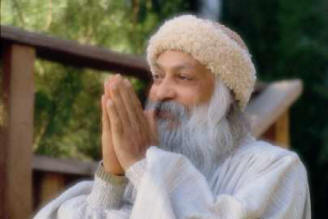
This belongs to one of the most notorious person in human history. Yes, in every sense Osho was notorious. But that very thing adds to his beauty. I fell in love with Osho when I was merely 16. He was a conman, as he calls himself. He used all the big names of Buddha, Jesus, Mohammed, Moses, Zarathustra, Krishna, Mahavira for his own purpose. The very core of his teaching was meditation. He developed nearly 112 meditation techniques.

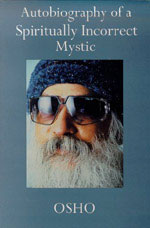
Osho never wrote a book in his life. All the books on his name are the written form of his oral discourse which spreads in 650 books. One may find it hard it believe that the man spoke much. This book, Autobiography of a spiritually incorrect mystic, the collection his talks with his dentist and caretaker when he was in public silence.

The very title of the book is eye catching. One may never understand Osho untill & unless one does not understand oneself. In his own words from the book:-

If you really want to know who I am, you have to be as absolutely empty as I am. Then the two mirrors will be facing each other, and only empitness will be mirrored. But if you have some idea, then you will see your own idea in me.

He also talks about his own story and believe it's extra-ordinary.

In college I used to wear a long robe, with a wrap- around LUNGI as it is used in India, and with no buttons on the robe so the chest is open. The principal told me, ' Coming to college without buttons is not according to etiquette .' I said to him, ' Then change the etiquette, because my chest needs fresh air. And I decide according to my needs, not according to anybody's idea of etiquette. '

My mother came to me, she was a little worried. She said, ' It is beautiful to see you dancing, but now you have started dancing with the girls ! ' She was concerned that if people in India see this, in the pictures, on the videos, they will be very much shocked. I said, ' So far, so good. But I am free- more free than Gautam Buddha, more free than Mahavira. Gautam Buddha did not have the guts to dance with the girls.

I want the world to know that I have ninety-three Rolls Royces because that is the only way to make any bridge. And then I can talk about the truth and enlightenment, too, on the side. Without Rolls Royce there is no communication at all. I know my business perfectly well.

In the book, he talks about his whole transformation, his enlightenment, his childhood, his youth and in the later part he talks about his commune and his groups. For him the Novo-Humane will be like Zorba-the Buddha. Dancing and enjoying like Zorba the Greek and silent from within like Gautam The Buddha.

Osho, for me, is the superman Friedrich Nietzsche used to talk about. He was the superman among the supermans. He was the best among the bests.

For generations to come of enlightened persons, Osho has created a difficulty now. Now, the primitive idea of enlightenment is no more and all the credit goes to Osho.

This book along with this person whom we call Osho, I love a lot.

Sunday, July 16, 2006

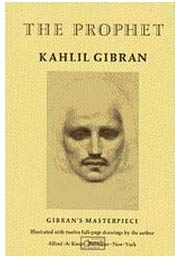
The Prophet : Kahlil Gibran


This book, The Prophet was first published in 1923. Kahlil Gibran, the author, instantly placed himself on highest platform of human thinking with the publication of this book.

Kahlil Gibran ( 1883-1931) , a Lebanese writer and thinker was versatile. He was an artist also and drew many sketches which are considered today as metaphysical. He setteled in New York, America. But apart from being an influential thinker, writer and artist Gibran was an alcoholic to the marrow. He died of liver cancer due to execissive drinking of alcohol.

The prophet is a story of a chosen man of god, Almustafa, who lives in a small town of Orfelis. He waited for twelve years for a ship to come which will take him to the land he was born. The ship did came but as he was about to board the people of town came to him to ask the questions of wisdom. Almustafa discourses them. This small book is nothing but commentries on life by Kahlil Gibran put on the mouth of Almustafa.

Gibran's way of seeing life is entirely different as is evident from his writing. He divided the book into various chapters such as Life, Love, Fear, Unhappiness, Law, Marriage, Punishment, Freedom, Sorrow, Friendship, Time, Blissfulness, Beauty etc etc. What Gibran writes, reminds me of J. Krishnamurthy.

Some of his writings:-

1. When love calls you, you should follow it. Although it's way is very difficult. When love opens it's wings, you should devote yourself to it even if the sword hidden in those wings may wound you.

2. Love on one hand crowns you and on the other hand crucifies you. On one hand it develops your soul and on the other hand cuts you in into pieces.

3. Your clothes hide what is beautiful in you but cannot hide what is ugly in you.

4. If you really want to witness death then open your heart fully to life. B'coz life and death are the same just as river and sea are the same.

5. Mostly, the kindness which sees itself in the mirror turns into stone.

And like this the story goes on. Almustafa departs from Orfelis with a promise to come back. The Prophet is Kahlil Gibran's masterpiece.

This book, I love a lot.

The Dhammapada


Another book that I am in deep love with is The Dhammapada.

The Dhammapada is to buddhism what the sermon on the mount is to christianity: a simple summary of it's teaching expressed with harmony and simplicity. Probably gathered from Buddha's direct who wished to preserve his wisdom.

Translated as the path of truth, The Dhammapada sets out the the route taken by the path, which can be followed by anyone on the quest for the higher good. If one can think in a way that leads us to act in accordance with the teachings of Buddha, we can begin to shape our lives and experiences in a postive, fulfilling way. This , says the Dhammapada, is the first step towards self-realization.

The book contains various teachings of Buddha, and the reader can see how practical they are even in today's world.
Some of them are:-


1. Our life is shaped by our mind; we become what we think. Suffering follows an evil thought as the wheels of a cart follow the oxen that draws it; and joy follows a pure thought like a shadow that never leaves.

2. " He was angry with me, he attacked me, he defeated me, he robbed me"-- those who dwell on such thoughts will never be free from hatred.

3. Even the gods emulate those who are awakened. Established in meditation, they live in freedom, at peace.

4. Let us live in joy, never hating those who hate us . Let us live in freedom from hatred.

5. Observing silence cannot make a sage of one who is ignorant and immature. He is wise who, holding the scales, chooses the good and avoids the bad.

Every sentence of the book is like a diamond.
For me, The Dhammapada is the core of the teachings of Buddha.

This book, I love a lot.

Saturday, July 15, 2006

The Katha Upanishad


The Katha Upanishad or Kathopnishad is basically not a book but it is an exercept taken from Yajur Veda.

It is a story of a brahmin boy Nachiketa whose father Uddalaka, once conducted a ritual. In the end of the ritual he had to give some cows to the participant brahmins as a gift. Being a cunning man Uddalaka chose weak & sick cows to gift. Nachiketa ,when saw the shrewdness of his father, started nudging him whom he will gift his son to. In the beginning Uddalaka simply ignored his son's question but finally he got irritated and said to Nachiketa that, " I will gift you to Yamraj ( the god of death) ".
Nachiketa took this as an order and started on a journey to Yamlok, the home of Yamraj.
On reaching Yamlok, he found that Yamraj was out. Therefore he decided to wait outside. He waited for three days without eating anything.
Yamraj, when came back, found Nachiketa waiting. On asking, Nachiketa narrated him the whole story. Yamraj was impressed with Nachiketa's will and obedience. He granted three wishes to Nachiketa.
For the first wish Nachiketa asked that ,' let my father's anger be cooled down and when I go back he would love me as ever'. Yamraj agreed.
For the second wish Nachiketa asked that, ' fire is behind all the pleasures of heaven. This earth is also made up of fire. So please give me the knowledge of power'. And Yamraj agreed.
For the third wish Nachiketa asked Yamraj to let him know the secret of all secrets the brahma - gyan itself. This time Yamraj was shocked. He tried to persuade Nachiketa to ask for something else. But Nachiketa did not moved. In the end Yamraj had to give what Nachiketa asked for.
This whole Katha Upanishad is the dialogue between Nachiketa and Yamraj about the brahma-gyan. And the whole dialogue is immensely beautiful. There are some places where the reader gets confused but one shouls always keep in mind that the thing which Yamraj is talking about, cannot be said , but only can be experienced.

Some of the dialogues are:-

Yamraj says,'The brahma is universal and omni-potent. But it cannot be achieved by listening discourses or reading books but it is achieved only by those whom it accepts from it's own'.

Yamraj says,' If your senses are indulged in the outer world, you are going to miss it. For example your eyes sees the whole outer world but does not sees it in your heart. Your ears hear everyhting but misses the sound of it.

Yamraj says,' One who knows this secret , will not speak. But he will be silent. And he spontaeously resides in the kingdom of it.

The author of this upanishad is unknown. By the way there are atleast 108 upnishads said to have been written nearly around 1500-600 B.C.

The word upnishad simply means to sit near the GURU and listen.

This book, I love a lot.

Meetings With Remarkable men : G. I. Gurdjieff


The first book I am mentioning here is G. I. Gurdjieff's Meetings with Remarkable Men. This is 2nd series of his collected work All And Everything.

G.I. Gurdjieff(1877-1949), literally unknown mystic was born in Alexandropol and trained in Kars as both physician and a priest. Later on he formed a society Seekers Of Truth and went on travelling the remotest regions of central Asia and Middle east. He also went to India and Tibet in order to seek the truth. This journey of his lasted for about twenty years. These years were crucial in the moulding of his thought. On his return, he began to gather pupils in Moscow but had to fled away during the Russian revolution. P. D. Ouspensky, a well known Russian mathematician, discovered Gurdjieff when he was hiding in the hills of Caucasus. Later on gurdjieff settled in the outskirts of Paris where he opened his Institute for the Harmonious Development of Man in 1922 on a larger scale.

This book of his, is an autobiographical account of his journey. The book contains the memoirs of Gurdjieff with numerous people whom he considered remarkable. These people namely his own father, his first tutor Dean Borsh, Bogachevsky, his companion during many journeys Captain Pogossian, his friend Abram yelov, Seeker like himself Prince Yuri, Ekim Bey, karpenko and Proff. Skridlov. For Gurdjieff, these men helped him to understand the very core of human intelligence. For me, these men were painters who painted the man whom we all know by the name of George Ivanovitch gurdjieff.

Every chapter of the book resembles not the remarkability of these men but also the insight of the author. What I liked the most was the style of writing the book. As if I was reading a novel or watching a movie. Gurdjieff mentions his father as a practical man. He writes in the book some of the subjective sayings of his father-

1. Without salt, no sugar.

2. He is deep down, because you are high up.

3. If a man is coward, it proves he has will.

4. Truth is that from which conscience can be at peace.

5. He is stupid who is ' clever'.

6. Happy is he who does not sees his unhappiness.

7. If you wish to be rich, make friends with the police. If you wish to be famous, make friends with the reporters. If you wish to be full--with your mother-in-law. If you wish to sleep--with your wife. If you wish to have peace--with your neighbour and if you wish to loose your religious faith make friend with the priest.

In the word of gurdjieff that man can be called remarkable who stands out from those around him by the resourcefulness of his mind, and who knows how to be restrained in the manifestations which proceed from his nature, at the same time conducting himself justly and tolerantly the weaknesses of others.

The book was first published in 1963. But the manusripts were complete in 1927 and was revised by Gurdjieff over a period of many years. The book was originally written in Russian and later on translated in English.

This book, I love a lot.